
As has become usual, one of these bestPRACTICE white papers begins with you (meaning a customer interaction). Usually on the phone, sometimes via email (and occasionally in person), then because I'm usually jotting down notes, if afterward it seems like the topic is good fodder for others, then I begin a file for later. Plus I also begin gathering supporting photos (because a picture is worth a thousand words). This brings us to today's article . . . throttle servo troubleshooting!

Thing is, troubleshooting throttle servos makes for a short catchy title - but - in reality we're going to delve deeper. We'll go into servo selection, while also touching on where and how it's mounted, plus how the linkage drives the throttle barrel, or butterfly.
As part of the topic, we're going to examine failed servos, and try and tease out why they failed (and by implication, what to avoid doing). We're even going to examine how throttle servo arm selection has a role to play.
I'm sorry this article runs long, but it's because I've been gathering notes for several years. And yes, I understand average modelers don't give it two minutes of consideration, but I'm writing this for the savvy who look at the big picture. I've lost track of guys who say I've got an old Hitec, that'll ge good enough and then later I hear, the servo failed, I wish I'd listened. Especially as I'm almost always guiding you toward the least expensive servo in our lineup!
Anyway, while this is not 100% comprehensive guide (else it becomes a dissertation), it nevertheless should be a useful foundation regarding best practice when buying a throttle servo, deciding where best to install it, and how to make up the linkage. So with that out of the way, let's dive in using the familiar Q&A format.
Questions & Answers
Q1. Normally I use a standard size servo for throttle of my 50cc warbirds but recently I'm noticed friends using tiny servos to actuate their throttle. They tell me it's because the torque requirements are nil and they save weight. Thinking if I can save 30 grams (more than an ounce), then I'm game, also. So what's the smallest and lightest servo you recommend for the throttle of my DLE55?
A1. While I totally respect wanting a lighter servo because grams 'do' add up, unless you simply don't have the space, then due to engine-vibration coming off a big gasser, I urge you to stick to a standard-class servo for the throttle of your warbird. And look, your friends are 100% right about a physically smaller and lighter servo saving an ounce - but - this also means smaller gears, and I'd bet a doughnut they're not taking this into account because there's more to the story than rated torque.
Basically, servos with smaller gears can be a problem on throttle because it's not just the egine vibrating but everything attached to it, to include the linkage. So when engine vibration feeds back into the servo, it accelerates wear between the teeth. And the smaller the teeth, the more rapidly the wear occurs due to the physics of materials. Saying this isn't an opinion, it's what happens to any servo, any model, any brand!
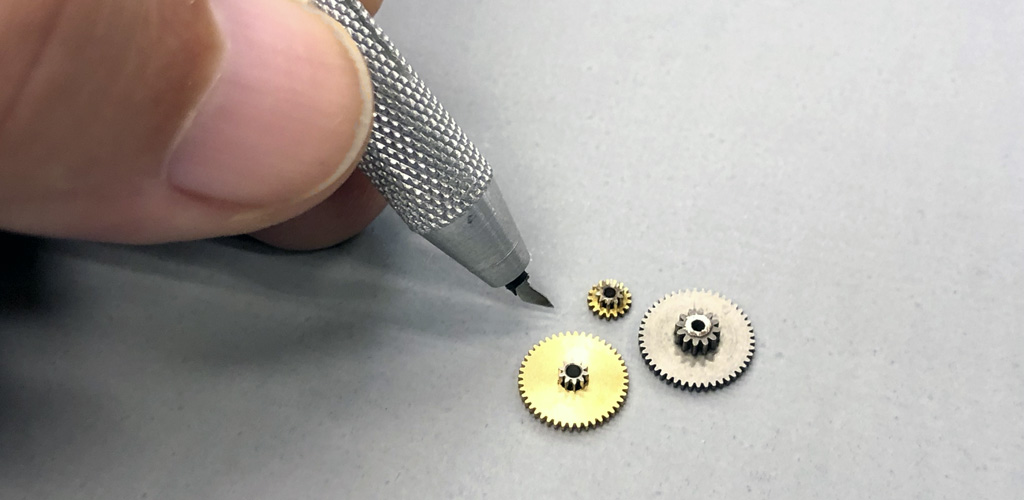
This next photo shows how gears get damaged in a submicro, or 9-gram class servo. This is one of our DS105CLHV, which at <21g offers up about the same torque as our DS90DLHV, which comes in at about 61g - so a desireable 40g weight savings (or about 1-1/2oz). Thing is, we don't think it's worth the risk that comes with the vibratory laods of a big gasser. And yes, those are the remains of gear teeth on the tip of that #11 X-ACTO blade.

- Gears within this 9-gram class failed under load because they're so small
Thing is, in terms of ruggedness and ability to resist vibration, while the DS105CLHV and DS90DLHV are rated at about the same torque output, it's a whole other story under vibratory loads. It's because the teeth of this minuscule 9-gram class servo will wear more quickly under vibratory laods. This in turn means as they get thinner and thinner they're subject to breakingmore readily. Wear happens between any two gears but just as a larger wing means a lower wingload if two models weigh the same, it's true between gears subject to the same laods. This is why a DS90DLHV, with much larger gears, soldiers on when a smaller servo gear train gives it up.
Major point being, bigger is better dealing with vibratory loads for any throttle servo . . . regardless of brand.
Background info
So because operating a throttle require very little torque, it makes perfect sense to use servos on the lower end of the output scale. Especially because price and torque are correlated (as a general rule, higher torque equals more money). Thus, using lower torque servos saves money.
But there's more to it. In this next photo, let's look at an array of four different size servos, all outputting about 100oz-in. We call them the Century Class because of the approximately 100oz-in torque rating. And please remember, I urge folks use the largest, which also happens to cost the least.
 - Century class servos (~100oz-in) range from 9-gram through micro, mini, and standard
In short, if you can fit a standard class servo into your model, we always recommend the DS90DLHV for throttle. Are there exception? Yes, and we'll get to them in a bit - but - unless you have a specific need for a specialty servo, perhaps one with a very low transit speed (we get into this later), then this is where the smart moneyalways goes for a throttle servo.
Note; it's what I use for the vast majority of my own models!
Now let's eyeball micro-class gears. Like the ones in our DS100DLHV (or DS150CLHV if you need something faster), while they're larger than the gears in a submicro, as you can see, they remain minuscule in size. So just like the submicro servos, the basic issue with tiny micro-class gears is quite simply . . . that they're very small.
Thus, the induced vibration begins an accelerated process of wear. And once they wear enough, then there's danger of the teeth breaking. Quite honestly? The smaller the gears, the less time it takes to occur.
- Close up of micro class gears as used in DS100DLHV and DS150CLHV
So as compared to the 9-gram class gears earlier, these micro-class gears are larger but not a heck of a lot larger. And in terms of withstanding vibratory loads, they are pretty much the same. So next up size-wise are the mini class servos. Ranging in output from 110-405oz-in, these use comparatively much larger gears. And perhaps the most useful mini-class is the DS110CLHV.
Now eyeball how much larger the individual gear teeth are. With the same vibratory imact loads (same engine, same RPM), then this translates into lower surface pressures between teeth (meaning reduced psi because the impacts are received between the teeth). Means it takes longer for wear to happen, which translates in a longer working life in a high vibration environment.
Note; microscopic spot welds between stainless steel bull and pinion gears. This serves to make the gear assembly more rugged.

- Mini-class gears are significantly larger han micro or 9-gram class
Q2. The throttle servo on my gasoline-powered Phoenix Spitfire quit on me. I've been through three servos and don't know what I'm doing wrong. First was a Hitec HS-85MG and when it died, I used another and it crapped out soon after. That's when I realized it was my fault because I was using a LiFe battery and they're only rated to 6V. So I bought a Hitec, but an HS-5070MH and everything was great for about six months and now it's died, also. And what sucked is I had to fly more than 10 minutes at part throttle until the engine ran out of fuel and died (so I could dead stick to a landing because the throttle cut wasn't working either). Glad I didn't crash! Anyway, since I don't want a repeat, which throttle servo in your lineup is best for my gasser? And I'd really like to keep using a micro because I mounted the throttle servo on the engine box and it's kind of close to the muffler so a bigger one might touch.
A2. So the servo quit 'and' the throttle cut wasn't working, eh? When it rains, it pours really is true! Anyway, I'm glad you sussed out what the deal was with the HS-85MG servos, which are pretty decent, but not high voltage and didn't blame them. As for the HS-5070MH failing, do you know what happened to it (ghe responded the gears failed). Anyway, I'm glad didn't crash your model. As for the servos not being one of ours, sadly, it could have been and it still may have failed. Why?
It's because reliability 'also' depends on proper installation plus the choice of servo pushrod and servo arm. What do I mean? Major point being, they (the Phoenix Models installation manual) show the servo being installed just behind the firewall and beside the fuel tank. However, as if it couldn't be worse, they show it connecting to the throttle butterfly with a 6 inch steel pushrod, which you used, but you mounted it closer to the engine on the motor box itself. Honestly? You did everything wrong and if I were presented with this installation, I'd urge you to never install a servo on the motor-box. Instead, always install it nearer the radio tray (significantly further back in the fuselage close to the two elevator servos).
This brings the benefit of being a greater distance from the source of vibration. Also, instead of a steel rod, I'd use a flexible Bowden cable arrangement to actuate the carb's linkage. Reason for this is a plastic pushrod better absorbs engine vibrations 'before' they reach the servo's potentiometer. And on top of that, I'd use a servo arm expressly designed to be used for throttle instead of whatever servo horn I had on hand. basically, plastic instead of metal, the heavier the arm the better it absorbs vibration. We offer one expressly for this purpose, PDRS105. So do others.
Look, the closer you mount the throttle servo to the engine, the worse. The goal is put as much mass between the source of vibration and the servo. Since there's more wood between the two the further aft you mount the servo, the best place to mount it is in the tail. Of course, that's not practical so we compromise. By way of example, Phoenix Models could have mounted it on to the motor box, but didn't. They plan for you to mount it a bit further aft. But my thought is I'd mount it even further aft than what they show! How far back, the closer to the elevator servos, the better. After all, it's on it's own independent plywood mount so it's easy to put it where you please.

- Mounting the throttle servo near the engine with a short steel pushrod isn't ideal
Also, the short steel pushrods they supply is a terrible choice material-wise because it acts like a superhighway for transferring destructive vibration to the servo. Reason is steel is much more dense than plastic, so vibrations transmit more efficiently, which is bad for our purposes
In short, mounting anywhere near the engine is bad juju for any throttle servo, and steel pushrods are too. Distance and plastic pushrods are your friends.
To the question had he been using a standard class servo (instead of either Hitec, or our micro servos) does this mean the servo wouldn't have failed? Nope? Proof, eyeball this next photo, which shows a DS90DLHV that croaked due to vibration. This one was mounted directly to the engine-box and the vibration was so bad it broke the plastic case (and he used it long the gear material worn off as the assembly vibrated itself to death became microscopic dust embedded in the grease). This ent on until the plastic case broke and it finally gave up the ghost! So the short answer is, even a standard size servo is not proof against a bad installation.
Major point being, installations subjecting servos to high vibratory loads lead even standard class servos to fail. In order of importance, the major problem leading to this servo's demise was proximity, in my opinion. The role of heat is unknown, but it's never good. And not to keep harping on it, but this could have happened to any servo, any brand.
In short, engine vibration is really hard on a servos. Add heat and it's the defnition of Hell on Earth.

- Don't focus on the failed plastic, but on the microscopic bits of brass embedded in grease
In summary so far, bigger is genuinely better when it comes to throttle servos because a larger servo has larger gears and these better withstand vibrations. However, engine vibrations will, over time, result in excess backlash developing no matter what. It just happens more quickly with smaller servos. Put another way, 'no' servo (regardless of the brand or size) is proof against developing excess backlash and subsequently failing because the secondary vibration (manifesting as tooth-to-tooth contact between gears) ultimately fails the gears.
Note; what usually dies first is the potentiometer. We call it vibration induced pot failure. Here's one more example before moving on. And again, it wasn't using one of our servos.

- Cam Devries proudly stands beside his 40% Pilot-RC Sbach 342
John Devries wrote in part about damage to his son's DLE170 powered 125 inch wingspan Pilot-RC Sbach . . .
‘The throttle servo (not ProModeler) died at 25% throttle. Cam made an approach and cut the ignition on final. Now dead stick he slightly underestimated the glide ratio. Touched down long, which would have been OK except for the irrigation pipe laying across the end of the field. The airplane is now mostly fixed.'
. . . and he went on to inquire about repairing the damaged servos (not the throttle servo, of course). Bottom line? I am specilating but I'd bet a doughnut the servo quit due to vibration. Whether it was the pot or the gear train in unknown but even pilots flying big expnsive models are experiencing this. Engine vibration is a big deal even with multi-cylinder engines, which everybody assumes run a lot smoother. But it's especially an issue with a single-cylinder gasser - we call the paint shakers.
However, when mounted on the motor box, what makes things worse is the servo is also contending with added heat. Makes the engine box an all around a bad place to mount a throttle servo, in my opinion. Why do the manufacturers do it this way? Simple, because it's cheaper to supply a 6 inch piece of 1/16in music wire than a Bowden cable. Anyway, since you always want to stack the odds in your favor, begin by using a physically largest servo you can install versus a smaller one. Nice thing is, it's also cheaper!
Anyway, and speaking of mounting, please review this article before proceeding.
Factors when selecting a throttle servo
So what are factors at work when selecting a throttle servo for gasser powered project? Cost is a big one, maybe the principal one for most, but so is performance (think XA models and 3D-oriented helicopters where speed enters the equation).
For example, how quickly the throttle servo reacts for a sport model or a scale warbird is not much of an issue. But if you're performing Harrier rolls, then throttle speed is absolutely an issue to consider. However, for most models, transit speed doesn't matter, which means the DS90DLHV is a popular choice.


Recaping, for a sport model, or a warbird like my own paint shaker equipped (DA-85) Mustang, I'm perfectly satisfied with a DS90DLHV for throttle (and another for choke). And I like using a PDRS105 (a seriously heavy duty glass-filled nylon servo arm because being plastic it helps damp engine-induced vibrations). This plastic servo arms is quite massive and is designed to accept a bog-standard 4-40 ball link as offered by DuBro, Sullivan, and others, or M3 hardware (either M3 or 4-40 works). Here are links to both
Selecting any link opens another browser instance in a new tab so you don't lose your place. Anyway, because I've saved up more than one query related to throttle servos, let's move on to the next one!


- A gnarly glass-filled nylon arm like this PDRS105 helps resist vibration induced damage
Q3. What throttle servo do you recommend for my Extreme Flight 78" Extra powered by a DA35?
A3. A good choice for any 3D-type model is going to be one where the transit speed is high because some maneuvers, especially rolling Harriers and torque rolls, require the servo to react very, very quickly. This means you want a really fast servo like the DS255BLHV.
Q4. I'm building a 35% CARF 2.6m Extra 330SC and will power it with a DA120. I fly very aggressive 3D maneuvers and went with your recommended DS635/DS845/1155BLHV on the flight controls. I also went with the DS255BLHV on throttle but am having second thoughts. This is my dream model and I don't care what it costs, what servo do you recommend for the throttle when money is no object?
A4. Honesty? The DS255BLHV is all the servo you need. However, when your money grows on trees, then without question the most suitable for this purpose is another DS635BLHV like you're using on aileron.
And yes, of course I know you don't need 635oz-in of torque to operate a throttle (but you don't need 255 either because 10oz-in would suffice). So what you're paying for is raw speed. How fast? It's rated at 0.042sec/60° vs the 0.047sec/60° of the DS255BLHV so it's actually a hair faster. Thus, hands down, this is our best for purpose 'if' you fly XA maneuvers (or have more money than God). However, I still maintain the DS255BLHV is fine for your needs - but - if you insist, then here's a link!
Q5. I fly a Zenoah G-26 powered helicopter, what would you recommend in the way of a throttle servo.
A5. For sport, a DS90DLHV is all you need. But please also use a plastic horn like our PDRS105 'and' instead of the metal linkage rod, substitute a short piece of inner Gold-N-Rod for the pushrod as it's all of three inches long and is sufficiently stiff to substitute for the steel riod and will help keep engine vibration for damaging the servo.
And if you're flying 3D-maneuevers (XA-maneuvers with helicopters are refered to as 3D-maneuvers), then either the DS255BLHV (or DS635BLHV). The latter for when money is no object - unusual for modelers - but not always. So I mention the DS635 just to cover our bases.
Q6. I've got an outrigger tunnel hull with two custom 29.5cc gasoline engines, what do you recommend for throttle servos? I need two.
A6. Boats, like helicopters, are HARD on throttle servos because you don't have much space for a flexible non-metallic Bowden cable, which is my preference for operating carburetors. Essentially, it's like the airplane guys mouting a servo on the engine-box - but - you guys don't have a chocie, you can't mount it a foot away! Anyway, beyond engine vibration (double trouble with twin 35s hammering on the structure), water transmitted shock (through the hull and engine bearers) plays a huge role, too. This is because at 70mph water is hard as concrete.
Honestly, all the factors mentioned above means paying special attention to servo mounting (review the mounting article linked below once again), plus pushrod material (just as for the previous guy, use a plastic pushrod instead of steel or carbon fiber rod), and use a plastic servo arm. These are all details worth paying close attention (more below). Review this article:
Anyway, a lot of boat guys like the DS90DLHV because they're relatively inexpensive. While slowish at 0.17sec/60° honestly, for a boat (and nearly all warbirds, sport model airplanes, and RC trucks, too), the servo's transit speed is generally a non-issue altogether. Seriously, transit speed doesn't matter so whypay for what you can't feel?
Any, in 2022 we shifted production fomr all-metal to all-stainless steel gears. This means they're durable as all get out and this is especially important at 70-80mph on water. Believe me, boats are harder on servos than pretty much any other RC application . . . and especially because your model has twin 29.5cc engines blasting away and vibrating like the hammers of hell. Word to the wise, eh?


- Note the all-steel gear train of the DS90DLHV, and sealing it up are 13 0rings
Q7. I've got a highly modified Losi 5iveT equipped with a 35cc gasoline engine. I've had two throttle servos quit on me and someone recommended ProModeler. What do you suggest in the way of a servo for this application?
A7. Big 1/5th scale gas-powered trucks like yours, and others like the 5iveB, Kraken RC's Vesla.5, HPI Baja, MCD's RR5 (plus FT-R and W5) are tough on a throttle servo because of;
- Vibration
- Dust/dirt
- Water
Look, an RC truck, almost by definition, operates in very a dirty environment. That, and you guys love playing submarine with them occasionally, so the 13 o-rings of a DS90DLHV servo especially will stand you in good stead, trust me.
Basically, large rigs like these are harder than pretty much anything on planet Earth on throttle servos because unlike a boat where the engine is on hardwood rails, or a model airplane where wood or fiberglass - both serving to attenuate a lot of vibration before it gets to the servo, within a rig the 35cc engine is pounding away on the servo whilst mounted to an alloy frame and thus, is transmitting engine-vibration with virtually zero attenuation because metal is excellent at transmitting vibrations. So the vibrations go directly into the servo through the engine mounts, and into potentiometer through the pushrod (usually short and made of steel). Rigs are a lot like a boat in this regard because there's a VERY short distance between throttle servo and carburetor arm. In a word, gas-powered 1/5th scale gas trucks are 'rough' on servos.
Two factors to think of. First, pushrod material is important, so avoid a 1/16 steel rod like the plague. Opt instead for short section if the inner piece of a Bowden cable to control the throttle because it's more flexible (but because it's so short, plenty stiff for accurate control). Do not under any circumstances ditch the rubber isolation mounts. I know it's popular to hard mount the servos but take my word for it, this is a singularly bad idea. you've been warned! Second, and further to this, and as with boats and model airplanes, I'd strongly advise the heavy duty PDRS105 servo arm because it'll help damp vibration from getting to the potentiometer.
Coming up we'll delve into pushrods (and best practice as it regards throttle pushrods, specifically).

Throttle servo linkages
First, it's important to understand the servo doesn't know (or care) what use you're making of it. E.g. whether it's function is controlling the throttle, elevator, or rudder - it simply doesn't matter. Ditto whether it's mounted within a boat, airplane, or model truck - again it doesn't 'know' anything about that.
Does this mean you can use a mini instead of a standard size servo if space is tight? Yes, absolutely. The real question is . . . should you? The answer then becomes . . . it depends! If you don't have the space, then it's macht nichts.


- A mini-class servo mounted to a PDRSS2M mount adapter
This photo shows a ProModeler mini-class servo mounted within an M2S mount-adapter, thus allowing it to be fitted in place of a standard class servo.
The answer to whether you should use a mini for a throttle servo is - it depends. First, if there's no room then it's Hobson's choice, right? But we always recommend using the largest that will physically fit because this means bigger gears and more servo mass (both useful for various reasons to do with damping vibration).
Potentiometers and the benefit of distance
Second, and here's the rub with a servo (any servo, ours, or another manufacturer's) vibration is tough on them. Tough on the gears (accelerated wear) and tough on potentiometers (early failure). Meanwhile, and for reasons unknown (but probably because it's cheaper to mount it far from the engine), there is a fondness amongst giant scale aircraft designers for placing the servo directly on the engine box, or immediately behind the firewall.
This is very bad because it means connecting to the carburetor requires a short straight linkage rod as if it were mounted in a boat/helicopter/truck model. And it's bad for more than one reason. Like it's very hot and it's subject to high levels of vibration. Unfortunately, this is how RC truck/heli/boat guys are forced to mount the servo because there's no room to relocate it further away from the engine. But airplane guys? You can always relocate it to the rear (and at the CG) within the wing opening a few feet away from the engine. This is much better.


- This is the worst possible connection . . . a direct steel pushrod and metal servo arm!
The above photo shows the worst connection you can make between servo and carburetor, with a short steel pushrod. And it's a bad idea on multiple fronts because in this instance, he's using an aluminum alloy servo arm, also! Mounting the servo on the engine box places it directly on the highest vibration surface of the whole aircraft and near the hot engine/muffler. This is tempting fate!
Note, this is a close up photo Shamus Coughlin intentionally mocked up and shared with us because I needed an example photo if a steel throttle pushrod operating the throttle of an engine. He subsequently switched out the steel rod for a short inner section of flexible plastic because short is relative. Over the course of a few inches, the plastic inner is plenty stiff enough to remain as effective as the steel pushrod whilst simultaneously, absorbing engine vibration better. We're grateful for his taking time to do this, and for granting us permission to show this example of what not to do.
Trucks, helicopters, and boats vs Airplanes
While truck, helicopter, and boat designers have no choice for mounting the servo in close proximity to the engine, the why for this with regard to model airplanes designers doing it comes down to money. I never mount a servo to an engine box and recommend you don't either. Not ever! In fact, with my gassers, I don't ever mount it within two feet of the engine! That, and I run a non-metallic Bowden cable from near the CG (2-3' away) where I mount the servo to operate the carburetor arm. Specifically? I favor the Sullivan brand Gold-N-Rod product. Available in increasing stiffness ranging from red, blue, and black, I use Sullivan's red 100% of the time. Why? Simple, because it helps absorb engine vibrations before they get to the vulnerable bits of the servo, the potentiometer and the gears.
This photo shows an excellent use of a Sullivan Gold-N-Rod for throttle pushrod.

 - We recommend using Sullivan's Gold-N-Rod, a Bowden cable setup, for throttle installations
So this close up photo demonstrates the use of a Bowden cable (in the form of a Sullivan Gold-N-Rod) for throttle control of a Zenoah G-62 engine mounted within Jim Simonitch's fantastic giant scale P-47 model (same airplane shown on final approach in a photo earlier in this article).
Reason for going to these extreme for the pushrod installation is to do with attenuating vibration when you don't have mass and distance to help. What's being hurt by a steel pushrod is the potentiometer. What makes pots subject to vibration damage is due to fundamental servo design. Let's briefly go into that by showing you where it's located.
Servo potentiometers, part 2
Below is a render of the cross section of a typical ProModeler servo. And please note; this isn't an unusual configuration for the potentiometer placement of any servo brand/model. In fact, it's probably what you'll find within every other servo on the market!
Do you see how it sits directly below the output gear, which is made of metal? If you connect something vibrating like mad to the output gear, the vibrations feed directly into the pot and throughout the gear train. Worse, there's absolutely nothing we can do about it as a practical matter on the servo design standpoint other than soft mount the servo and use a a connection between carburetor and servo that absorbs/dampens vibration as much as possible.


- The potentiometer directly engages the output gear - no isolation at all.
The above computer render shows the section view of a servo, as if sliced down the middle, with an arrow pointing to the potentiometer, which is the component within a servo that most often fails due to vibration.
Anyway, the pot sits directly below the output gear and is connected mechanically to the output shaft on which we install the servo arm. So whenever a modeler uses a steel pushrod for the throttle - the engine vibrations are being transmitted directly into the potentiometer and the gears. For the pot especially this is bad. It means the pot's lifespan is being degraded much faster than would otherwise be the case. How much? From thousands of flights/runs to dozens or low hundreds. And sometimes just a few before failure! Modelers using a steel pushrod are acting almost as if they wanted to destroy the function of the servo - not kidding!
Basically, the pushrod picks up engine vibrations and feeds these destructive vibrations directly into the potentiometer itself. Worse, steel does absolutely 'nothing' to attenuate the vibration. Frankly, it's no wonder the throttle servos may quit working in short order with gassers. And it's entirely to do with the potentiometer being eaten alive by the engine vibration!
Fortunately, if your servo dies, it's probably just the potentiometer and we offer replacement potentiometers. Moreover, they're mostly easy to replace (three solder joints) so it's a DIY for a lot of modelers. The upshot is; unlike other brands, because we'll sell you just the pot you can fix it yourself instead of being forced to send it in for repair. The other guys? It pays to ask about this ahead of time, capice?
This begs the question, why not use a Hall Effect sensor instead of a potentiometer? Good question. Reason has to do with how these fail versus how a pot fails. Sudden or slowly. Learn more with this article.


- Killing a potentiometer isn't the end of the world - it's an easy fix.
The above is a close up photo of a bin of Nobel brand potentiometers as used in ProModeler servos. One of these is often the fix to a dead throttle servo.
Q8. Is there a solution for dealing with engine vibration?
A8. Well, yes, there is. In a nutshell, it involves three factors;
- use a non-metallic pushrod, and
- relocate the servo from the engine box, and
- use a plastic servo arm.
When modelers are forced to mount the servo on, or near the engine box (or when used in a boat or truck) then using a very short pushrod made of plastic instead of steel is the next best thing to relocating the servo. That, plus a polymer servo arm to help further damp vibration.
So for car/boat/helicopter guys, as with aircraft modelers, we suggest switching from a short steel pushrod to just the inner section of a red Gold-N-Rod, instead. Why? It's because within a mere 2-6" length the usually flexible cable is actually plenty stiff enough to operate a carburetor's butterfly valve. And use plastic links instead of metal. And we also prefer using a polymer servo arm like the PDRS105 instead of an aluminum servo arm, for the same reason. And I'm not yapping about this to sell a $2 arm and promote Sullivan but because all this plastic attenuates the vibration better.
Anyway, Sullivan sell these Bowden cable set ups with red, blue, and black sheaths (most flexible to least). In my experience, the blue sheath stuff is OK for model airplanes (the black is designed for 4-40 hardware and is far too stiff), but the lightweight red/yellow is my overall favorite. And while maybe we should, we don't sell Sullivan or DuBro pushrod hardware, sorry.
Q9. I'm trying to decide between a DS90DLHV and a DS255BLHV for the throttle servo of my 96" F4U Corsair. I know you say don't really need the speed of the DS255BLHV but is this one 'better' than the DS90DLHV? I figure it is since it costs twice as much, but why is this?
A9. 'Better' comes down to servo's motor and its construction, e.g. torque if you need more and all-alloy if this will matter for durability and impact resistance. In honest truth, there's really no 'better' in the ProModeler line up. Not whether a servo costs $30 or more than $300. Every single one is our best . . . no kidding.
Thus because the DS255BLHV (and its sister servo, the DS415BLHV) have steel gears like the DL-series has all-steel gears and BLO1, BLS1, and BLS2 servos, as well, there's no 'better' in terms of gears in the standard line up regardless of cost. What may possibly makes one servo better than an other is case construction, transit speed or torque rating, but as far as the servo goes, we litterlay make every single one pick of the litter against our competitors.
We feel this makes ProModeler servos better overall, but one is not 'better' than the other in the classical sense. The difference in a performance almost entirely comes down to the servo's motor. To learn more about this, I recommend you review this material . . .


. . . and as usual, whenever you click one of these links, the page conveniently opens in a new browser tab so you don't lose your place.
Q10. I've read where you recommend mounting servos on the center of gravity, why is this?
A10. Yes, I mention doing this frequently and in part it's to do with the dumbbell effect, or moment of inertia (more simply, just 'moment'). There are several added benefits of mounting the servo on the CG and they're to do with attenuating vibration as well as the effects of interference from the ignition system when it's failing.
- With the servo at the CG, the model's structure forward of the servo helps attenuate (dampen) some of the vibration from the engine.
- Not having a steel pushrod eliminates the worst of the vibration from being transmitted into the pot (plus the possibility of ignition noise making its way into the servo and driving it crazy).
- A plastic servo arms attenuates vibration better than metal.
- Specifically to your question; the model tumbles about the CG more easily because the mass of the servo is right on the CG (remember the dumbbell effect). No, it's not much with a 2-oz servo but every little bit helps. Also, remember, the dumbbell effect, for example using a bar in the gym with two 20 pound weights at the ends, is harder to spin like a majorette twirling a baton than if you move the weights inward to the center of the bar. Though, and in all honesty, regarding number four, only the best pilots can possibly tell the difference involving moving a few ounces to the CG - but it's our view every bit helps.
- And finally, perhaps most importantly with gassers using ignition modules, when the shielding begins to fail the module becomes a transmitter broadcasting noise on all frequencies. About the only thing that may save your model's receiver form being swamped by spurious signal is physical distance between the module and the receiver. Moreover, when a servo is on the motor box, then it and the extension act like an antenna for the receiver to pick up the signal. Yup, the extension is the highway across the castle moat's like a lowered drawbridge, right into the keep for enemy troops.


- A very savvy modeler mounts things near the CG when possible, even servos
In the above photo you see how master builder Mark Armbrust mounted the throttle servo in the nacels of his twin engine replica of the famous Fokker G1. And by relying on distance plus a Sullivan Gold-N-Rod for making the linkage instead of a steel pushrod, he helped preclude vibration induced damage to his throttle servos.
Q11. I know you say don't do it but I 'want' to mount the throttle servo on the motor box. Is there anything I can do to make this easier on the throttle servo?
A11. You know I'm going to say please reconsider - but - if for whatever reason you can't/won't then our recommendation is - at a minimum - to ditch the short 1/16" steel pushrod. Instead, resort to using a short section of the inner part of a Sullivan Gold-N-Rod. At less than 6" it's plenty stiff to do the job. And use plastic links like in this photo.


- Best practice involves a flexible piece of Sullivan Gold-N-Rod inner.
Why a plastic? Principally because the plastic helps attenuate vibration. Maybe enough to 'maybe' let the servo live. Also, please consider using a plastic servo arm like the PDRS105 as well because it's bulk helps dampen vibration also.
However, the biggie in all this is the plastic throttle pushrod vs. 1/16' steel pushrod. And we know it looks trick, and we appreciate your buying our fancy aluminum throttle arm, but the less costly plastic arm is a FAR better choice, in our opinion.
And yes, we know opinions are like belly buttons because everybody has one but remember, we are the folks producing your servos so this should count for more than some anonymous internet expert's opinion, capice?
Note; I've argued with my friend not to mount the servo on the engine box (above photo), but I got nowhere. At least he usued the plastic pushrod!
Closing thoughts
Some internet expert always brings up expansion/contraction of a Gold-N-Rod as a reason to not use it. As if steel doesn't expand and contract also, duh! Anyway, this is totally a non-issue, believe me. Remember, when dealing with a paint shaker of a gasser engine, the goal is to attenuate vibration so your servo will live a longer life because being stuck in the air at part or full throttle and dealing with a dead throttle servo sucks! The slight change in length between summer and winter is easily within the use of a trim tab to correct.
Last thing
Gasoline ignition engines rely on either a magneto for ignition or a standalone battery-powered ignition module. I'll close with this, I wish I could persuade modelers to never locate a throttle servo within two feet of either of these. Why?
It's because the servo lead is the drawbridge over the moat for ignition noise making it into the castle (e.g. into the receiver). No, not when everything is working as designed, but when things go pear shape and you've got stray RF making racket. That's when, quite honestly, there's nothing better than distance from the source.
Toward that goal a) I try hard to achieve two feet between receiver and any control avionics wiring, and b) I 'always' use a non-metallic Bowden cable to control throttle (and choke if so equipped).
I've mentioned it more than once (and we don't sell them so I don't have a dog in the hunt) but I favor the Sullivan brand Gold-N-Rod product (preferring the red, which is the lightest made for purpose). Anyway, I never 'ever' use a 1/16 metal pushrod like so many favor. This, because the potentiometer lives directly beneath the splined output shaft and the vibration is akin to touching the shaft with a vibrating marking tool (electric scribe).
After all, the servo has a hard enough life dealing with engine vibrations as it is, why make the pot deal with anything more? My first gasoline engine was a magneto ignition Quadra 35 a Canadian fellow by the name of Dario Brisighella introduced me (and many thousands of modelers) to almost 40 years ago.
In the years since, I've operated many, many gassers and I'm one of the guys fellows turn to when they have engine problems because I seem to have an affinity with them. My point? When everything is working right, they're a lovely motive source of economical power.
However, it's when things go to Hell that you'll come to appreciate what I'm telling you about mounting your throttle servo as far from the ignition source as is practicable. And that this coincides with it being as far from the source of heat and vibration is a lovely happenstance.
Let me repeat . . . I prefer mounting a throttle servo near the CG, with about two feet of distance between the paint shaker up front (and the ignition). Trust me and consider these words to live by from a very experienced old hand.


- SolidWorks render of DS255BLHV showing component layout


